
Lantzville’s drinking water system is a blend of local groundwater sources and regional supply connections. As weather patterns shift and water demands evolve, understanding the hydrogeology beneath our feet and the inter-municipal agreements supporting our supply is important to evaluating the future of Lantzville’s water infrastructure.
The Reality of Our Local Aquifer
Lantzville primarily relies on municipal groundwater wells tapping into a localized, semi-confined aquifer.
Drought & Yield Impact: Under typical dry seasonal conditions, local groundwater levels naturally drop, resulting in roughly a 15% reduction in well yield. However, during recent severe summer droughts, the aquifer has experienced supply drops of up to 30%.
Spatial Limits: Hydrogeological testing indicates that drilling additional municipal wells within the current footprint will not increase overall capacity. Wells placed in close proximity create direct draw interference, simply pulling from the same finite supply rather than opening new water sources.
Hydrogeology and Well Water Quality
While municipal wells undergo continuous treatment and monitoring, private wells in unserviced areas draw directly from underlying clastic sedimentary rock formations.
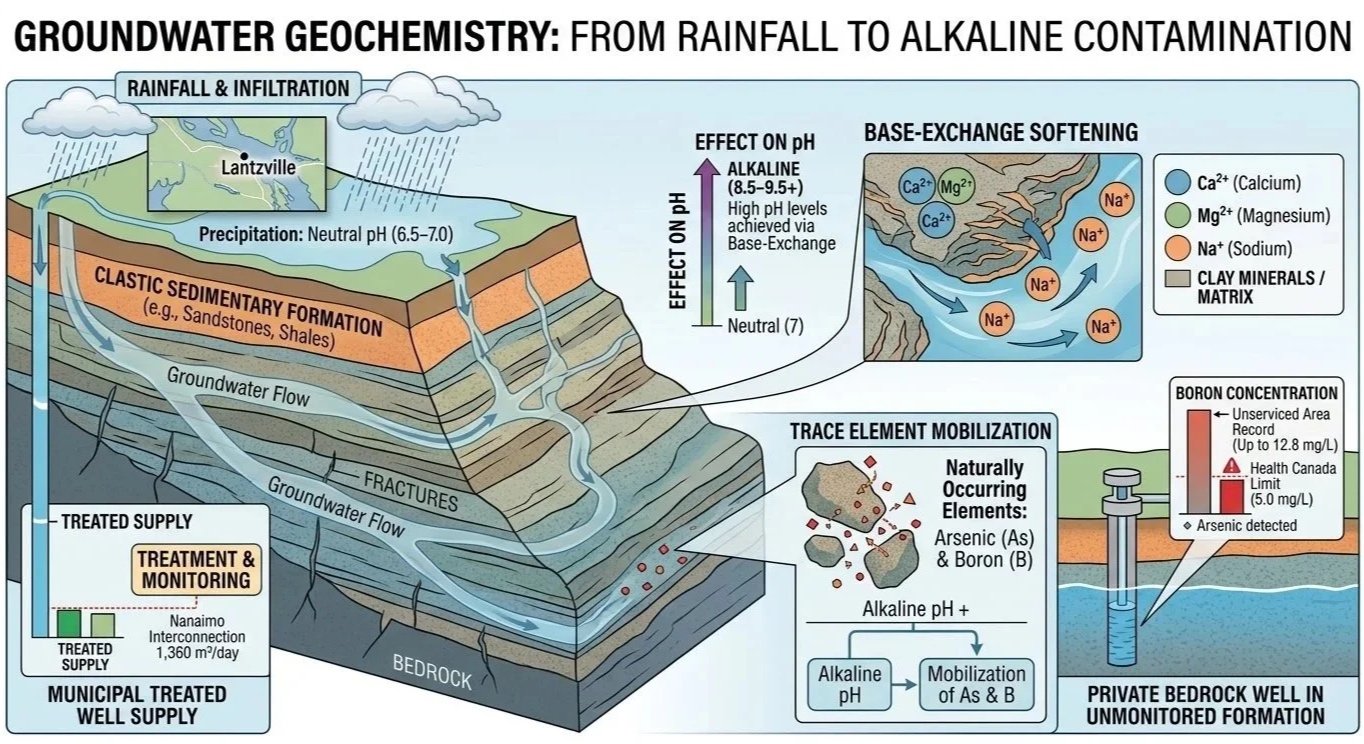
In these specific geological layers, naturally occurring geochemical base-exchange softening drives groundwater to highly alkaline pH levels. This chemical reaction can mobilize trace minerals from the surrounding rock, releasing naturally occurring boron and arsenic into private well supplies. Historical well records in unserviced areas have documented localized boron concentrations reaching 12.8 mg/L, more than double Health Canada's Maximum Acceptable Concentration of 5.0 mg/L.
The Lantzville-Nanaimo Water Agreement
To hedge against seasonal aquifer declines and supply vulnerabilities, the District activated the Lantzville-Nanaimo Water Agreement.
Key Operating Capacity: The interconnection allows Lantzville to draw up to 1,360 cubic meters per day of treated surface water supplied by the City of Nanaimo’s South Fork Water Treatment Plant.
This agreement provides a secondary, treated surface water source to supplement local groundwater, particularly during peak summer months or prolonged dry spells.
Community Perspectives
The Centralized Infrastructure View
Proponents of expanding centralized water services emphasize long-term public health and climate resilience. From this viewpoint, relying on private groundwater in an era of lengthening summer droughts and localized boron or arsenic contamination presents ongoing risks to property owners. Expanding the centralized network—backed by the Nanaimo interconnection—is seen as the most reliable way to guarantee standard water quality testing, consistent fire-suppression storage, and protection against shifting climate patterns for all properties.
The Private Autonomy View
Conversely, many property owners in unserviced areas have invested heavily in deep private wells, sophisticated filtration systems, and reverse-osmosis units to ensure their drinking water meets health standards. From this perspective, residents who have successfully managed their own potable water supply independently should not be required to connect to municipal systems, pay mandatory hookup fees, or take on municipal debt for centralized extensions they do not currently require.
A Question for Lantzville's Future
How should the District balance investing in centralized network extensions to protect unserviced areas from well contamination while respecting the financial investments of residents who have already secured private water systems?
